

MIA Madrid Investment Attraction
Ayuntamiento de Madrid
♿ Accesibilidad
Tamaño de texto
Alto contraste
Escala de grises
Subrayar enlaces
Fuente para dislexia
Cursor grande
Reducir animaciones
Fondo claro

Autor: epolomor

  • Resilience in adversity: Madrid helps Spain hold its nerve

    International investors have had precious little to cheer about of late. Trade barriers are piling up, security clearances stretch ever longer and geopolitics is as volatile as at any point since the Cold War. Yet amid the turbulence Spain has proved sturdier than many of its peers, and Madrid has repeatedly demonstrated that it can keep global capital engaged even when the wider tide is running out.

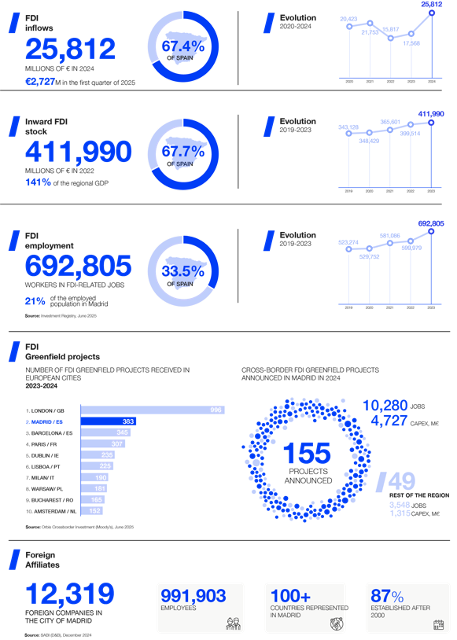
    The opening quarter of 2025 is a case in point. At first sight the €4.07 billion in foreign direct investment (FDI) booked nationwide looks subdued beside the first-quarter averages of the past decade. But that headline masks an important truth: Spain continues to attract sizeable, productive commitments when much of the world is experiencing double-digit declines. Equity and reinvested earnings still account for the lion’s share of inflows (€3.46 billion), while the inclusion—since 2024—of intragroup financing gives a clearer picture of the multinational ecosystems already rooted in the country.

    Madrid’s performance is even more striking. The region drew €2.73 billion in gross inflows between January and March, two-thirds of all foreign capital entering Spain. Catalonia captured €451 million (11.1%), Cantabria €177 million (4.3%), the Balearics €140 million (3.4%) and Valencia €125 million (3.1%), with the rest scattered thinly across the map.

    Net of disinvestments, the capital still banked €1.51 billion—ample evidence that foreign groups are rolling forward rather than rolling back.

    Quarterly data can exaggerate swings caused by one-off megadeals and by the seasonal rush of filings at the end of the year. Even so, Madrid’s resilience rests on solid structural ground. Holdings vehicles (ETVEs) now play only a minor role, signalling that the money coming in is linked to real projects rather than treasury engineering.

    Almost half of the funds received in early 2025 financed brand-new facilities or expansions, underlining investors’ long-term faith in the region’s talent pool, infrastructure and pro-business stance, while cross-border acquisitions took 33.3% and follow-on expansions 24.9%.

    In a mirror image of 2024, corporate investors supplied nearly half the investment in Madrid (44.9%), ahead of private collective vehicles such as PE and VC funds (37%), individual investors (7.1%) and sovereign wealth funds (6.1%).

    The United Kingdom, France and Singapore lead the way in 2025

    Drill down into the origins of Madrid’s first-quarter investment and an eclectic line-up emerges. The United Kingdom leads the field with €544 million (19.9%), channelled mainly into information services and back-office administration. France follows on €421 million (15.4%), driven by headline deals in energy supply and financial services. Singapore – whose tech investors have grown increasingly comfortable in Madrid’s cloud and data-centre scene – posted €388 million (14.2%), again heavy on information services. The United States chipped in €331 million (12.1 %), skewed towards real-estate activities, while Mexico completed the top five with €250 million (9.2 %), splitting its bets between food-and-beverage trade and real estate.

    Sectorally the picture is equally concentrated. Information services banked €799 million (29.3%) in Madrid, continuing the surge seen in 2024. Real-estate activities claimed €395 million (14.5%), financial services drew €254 million (9.3%), while energy supply secured €241 million (8.8%) – notable in an era when renewable deals are slowing worldwide. Rounding out the leaders were accommodation services with €176 million (6.5%), reflecting the capital’s resilient tourism bounce-back.

    Taken together, the country and sector breakdown underscores a familiar story: Madrid’s ecosystem of multilingual talent, digital infrastructure and high-density corporate services continues to attract Anglo-Saxon capital, the French energy majors and a rising cohort of Asian and Latin American investors.

    The long view: stock counts still paint a resilient picture

    Quarterly gyrations aside, what matters for wages, tax receipts and technology spillovers is the stock of foreign capital embedded in the region. On that score Madrid’s trajectory remains unambiguously positive. The Registry’s stock series – derived from corporate annual reports and therefore subject to an 18-month publication lag – shows €411.99 billion of productive FDI on the books in 2023. That is 3.1% higher than in 2022 and fully 161% above the pre-crisis baseline of 2007.

    Put differently, the stock now equals 141% of regional GDP, or €61,375 per citizen. Madrid’s share of Spain’s overall inward FDI stock has crept up to 68%, five percentage points more than in 2007 and far ahead of Catalonia (13%), the Basque Country (4.8%), Asturias (3.0%) and Valencia (2.7%).

    Behind the headline growth lie two forces. First, Madrid’s services-heavy economy – hosting the headquarters of most blue-chip Spanish multinationals – naturally intermediates inward flows destined for projects across the Iberian Peninsula and, increasingly, Latin America. Second, the region has succeeded in anchoring life-cycle investments: once a foreign manufacturer or data-centre operator establishes a Spanish hub in the capital, the tendency is to reinvest earnings locally rather than repatriate them.

    Global investors are plainly more cautious in 2025, and Spain is not immune. Yet even in a quarter when flows receded sharply, Madrid continued to dominate the national scoreboard and to diversify its base of source countries and sectors. The task for MIA now is twofold: keep the door open to productive newcomers in an era of tighter screening, and convert today’s smaller trickle into tomorrow’s larger stock. On recent evidence, foreign capital still judges that Madrid is worth the wait.
  • La inversión extranjera impulsa el empleo en Madrid mientras las multinacionales refuerzan su presencia

    Una década de crecimiento sostenido: el capital internacional dinamiza el mercado laboral madrileño

    El capital extranjero continúa transformando el panorama económico de Madrid. Los últimos datos del Registro de Inversiones Exteriores —gestionado por la Secretaría de Comercio, dependiente del Ministerio de Economía, Comercio y Empresa— reflejan el creciente peso de las empresas controladas por inversores internacionales en el empleo de la capital.

    A cierre de 2023, la región de Madrid contabilizaba 692.805 empleos vinculados a inversión extranjera directa (IED), lo que supone un incremento del 15,5% respecto al año anterior. Esta evolución consolida una tendencia alcista que se prolonga ya durante nueve años consecutivos, desde el mínimo registrado en 2014, y que ha resistido incluso el impacto de la pandemia de COVID-19. En comparación con 2007, el empleo asociado a la IED en Madrid ha crecido un 77%.

    Madrid destaca de forma clara en el contexto nacional. La región fue responsable de más de la mitad del aumento del empleo vinculado a IED registrado en España el último año. Además, concentra ya el 33,5% del total de puestos de trabajo generados por inversión extranjera en el país, consolidándose como principal destino del capital internacional. A continuación, se sitúan Cataluña (19,7%), Andalucía (10,5%) y la Comunidad Valenciana (6,5%).

    Pero la relevancia de estas cifras va más allá del volumen absoluto: en 2023, el empleo generado por empresas extranjeras representó el 20,7% de las personas ocupadas en la Comunidad de Madrid, lo que pone de manifiesto el creciente peso estructural de la inversión internacional en la economía regional.

    Estos datos proceden de las memorias anuales que deben presentar las empresas extranjeras con actividad en Madrid. Dado que las empresas disponen de hasta siete meses tras cerrar su ejercicio contable para remitir los datos, y que posteriormente es necesario procesarlos y normalizarlos, existe un desfase temporal que hace que la información más actualizada sea la del ejercicio 2023.

    Principales inversores: los socios tradicionales refuerzan su posición

    La inversión extranjera en Madrid se concentra en un grupo reducido de países. En 2023, los diez principales países inversores generaron el 86,5% del empleo asociado a empresas foráneas en la región.

    Francia se mantuvo como el principal país inversor, con 166.927 empleos (24,1% del total), tras crecer un 9,8% respecto al año anterior. Le siguieron Estados Unidos, con 128.934 empleos (18,6%), impulsado especialmente por el sector tecnológico, y Reino Unido, que alcanzó los 87.526 empleos tras sumar más de 27.000 nuevos puestos en un solo año, especialmente en hostelería y restauración.

    A continuación, se situaron Alemania (67.414 empleos, 9,7%) y México (30.617 empleos, 4,4%). Completan el grupo de los diez principales inversores Suiza (26.957 empleos), filiales de empresas de españolas en el exterior (inversiones circulares, 24.842 empleos), Países Bajos (24.668), Italia (22.591) y Suecia (18.908).

    En términos absolutos, las empresas estadounidenses fueron las que más empleo nuevo generaron en 2023 (+30.374), gracias a la fuerte demanda de servicios tecnológicos. Las compañías británicas añadieron 27.192 empleos, fundamentalmente en hostelería, mientras que las firmas francesas generaron cerca de 15.000 nuevos puestos, con especial protagonismo en almacenamiento y actividades anexas al transporte, servicios a edificios y sanidad.

    Los Países Bajos aportaron más de 8.172 empleos adicionales, centrados en servicios administrativos y obras civiles, y las empresas suizas sumaron también cerca de 8.000 puestos, revirtiendo el descenso del año anterior gracias al impulso de las actividades de recursos humanos y empleo.

    Por el contrario, se registraron descensos en el empleo vinculado a filiales de empresas españolas en el extranjero (- 4.755), debido probablemente a reorganizaciones societarias como el traslado de Ferrovial a Países Bajos. También se redujeron los empleos vinculados a Luxemburgo (-3.663) y México (-3.190).

    Es importante interpretar estos movimientos con cautela. No siempre reflejan creación o destrucción real de empleo, sino que en muchos casos pueden responder a reestructuraciones societarias —cuando una compañía pasa a estar controlada por un nuevo inversor extranjero— o a diferencias en la forma de declarar los datos al Registro (empleo medio anual frente a plantilla a cierre de ejercicio), lo que puede generar oscilaciones significativas en sectores estacionales o con grandes proyectos puntuales, como recursos humanos u hostelería.

    Un modelo basado en los servicios: dónde contratan las multinacionales en Madrid

    Desde el punto de vista sectorial, el empleo generado por empresas extranjeras en Madrid se concentra mayoritariamente en los servicios, que representaron el 80,2% del total en 2023. Le siguen la industria (15,5%), la construcción (4,2%) y el sector primario (0,1%).

    Los sectores con mayor volumen de empleo fueron el comercio minorista (82.523 empleos, 11,9%), la programación y consultoría informática (74.606, 10,8%), el comercio mayorista e intermediarios (55.614, 8,0%) y los servicios de comidas y bebidas (50.397, 7,3%), reflejo de la recuperación del turismo y el consumo interno.

    También destacan el almacenamiento y transporte (22.404 empleos, 3,2%) y las actividades sanitarias (22.196, 3,2%). En total, otros dieciséis sectores superaron los 10.000 empleos generados por empresas extranjeras en Madrid durante 2023, lo que evidencia la creciente diversificación de la inversión internacional en la región.

    Este perfil sectorial refleja la capacidad de Madrid para atraer proyectos multinacionales tanto en actividades de consumo como en segmentos de alto valor añadido como el software, la ingeniería, la logística avanzada o los servicios profesionales.

    La fortaleza de Madrid como polo de atracción se basa en múltiples factores: una localización estratégica, infraestructuras de primer nivel, capital humano cualificado y conexiones institucionales con América Latina y Europa. A ello se suma un entorno regulatorio estable, seguridad jurídica y alta calidad de vida.

    Perspectivas: una economía cada vez más internacionalizada

    Los datos confirman que la inversión extranjera no es un fenómeno coyuntural en Madrid, sino un componente estructural de su economía. Con más de uno de cada cinco empleos generados por empresas internacionales, el peso del capital foráneo en la configuración del futuro económico madrileño es ya incuestionable.

    En un contexto global de incertidumbre geopolítica y reordenación de las cadenas de suministro, Madrid sigue ofreciendo estabilidad, escala y un ecosistema propicio para los inversores internacionales. El desafío será consolidar esa confianza y orientar la inversión hacia la creación de empleo de calidad, diversificado y sostenible.

    A medida que las grandes corporaciones refuerzan su presencia en la ciudad y su ámbito metropolitano, resultará clave mantener un ecosistema competitivo, innovador y abierto al mundo. Por el momento, los datos son elocuentes: la inversión internacional no solo está presente en Madrid; está impulsando decididamente su crecimiento.

  • Foreign Investment Powers Job Growth in Madrid as International Firms Deepen Local Footprint

    A decade of resilience: foreign capital drives Madrid’s labour market

    Foreign capital continues to reshape the economic landscape of Madrid. The latest figures from Spain’s Registry of Foreign Investment—overseen by the Secretariat of Trade under the Ministry of Economy, Trade and Enterprise— highlight the growing influence of foreign-owned companies in the region’s labour market.

    By the end of 2023, Madrid registered 692,805 jobs linked to foreign direct investment (FDI), marking a 15.5% increase over the previous year. This growth crowns a decade-long trend: since reaching a low point in 2014, employment generated by foreign-controlled firms in the region has climbed steadily—withstanding even the COVID-19 disruption in 2020. Compared to 2007, these jobs are now 77% higher in number.

    Madrid’s performance stands out nationally. The region was responsible for over half of the total increase in FDIlinked employment across Spain last year. It now hosts 33.5% of all foreign investment-related jobs in the country, consolidating its status as Spain’s foremost destination for international capital.

    Equally telling is the ratio of these jobs to Madrid’s broader workforce: in 2023, employment tied to foreign-owned firms accounted for 20.7% of the region’s total employed population—a clear sign of international investment’s growing weight in the local economy.

    It’s important to note that these employment figures come from the annual reports filed by foreign-controlled companies operating in Madrid. Businesses have up to seven months after closing their books to submit this information, and the subsequent processing and harmonisation of data typically takes additional time. As a result, the most recent data available corresponds to the 2023 financial year.

    The key investors: traditional partners lead the way

    Investment in Madrid is concentrated among a core group of countries. In 2023, the top ten investor nations accounted for 86.5% of all employment generated by foreign-owned firms in the region.

    France remained Madrid’s largest investor, responsible for 166,927 jobs—24.1% of the total—following a 9.8% year-onyear increase. The United States came second with 128,934 jobs (18.6%), bolstered by strong growth in the information technology sector. The UK followed with 87,526 jobs, after adding more than 27,000 new positions in just one year— mainly in the food and beverage services industry.

    Germany (67,414 jobs, 9.7%) and Mexico (30,617, 4.4%) rounded out the top five. The remaining top-ten investors included Switzerland (26,957), Spanish companies’ foreign affiliates (24,842), the Netherlands (24,668), Italy (22,591), and Sweden (18,908).

    In absolute terms, U.S. companies created the largest number of new jobs in Madrid in 2023—over 30,000—driven by surging demand for IT services. British firms followed with 27,192 additional roles, as the region’s hospitality sector expanded. French companies added nearly 15,000 jobs, with notable gains in warehousing and transport-related activities, facilities management, and healthcare.

    Dutch firms created more than 8,000 jobs, particularly in administrative services and civil engineering, while Swissowned companies added nearly 8,000 roles—rebounding after a dip in 2022, especially in employment services.

    On the other end of the spectrum, employment declined among affiliates of Spanish multinationals abroad (-4,755), largely due to reporting changes linked to Ferrovial’s relocation to the Netherlands. Luxembourg (-3,663) and Mexico (- 3,190) also saw declines.

    It’s important to interpret these shifts with caution. Not all job increases or losses reflect real changes in economic activity. Some may be due to changes in company ownership—where control shifts from one country’s investor base to another—or to variations in how employment figures are reported to the Registry (e.g., average annual employment vs. year-end headcount), which can significantly affect sectors with seasonal or project-based employment.

    A service-driven economy: where international firms are hiring in Madrid

    In sectoral terms, foreign-owned firms in Madrid are heavily concentrated in services. This category represented 80.2% of all FDI-related employment in the region in 2023, far ahead of industry (15.5%), construction (4.2%), and the primary sector (0.1%).

    The top-employing sectors included retail (82,523 jobs, 11.9%), IT consulting and programming (74,606, 10.8%), and wholesale trade (55,614, 8.0%). The hospitality sector—particularly food and beverage services—also stood out, with 50,397 jobs (7.3%), reflecting both domestic consumption and Madrid’s strong tourism recovery.

    Other notable sectors were storage and logistics (22,404 jobs, 3.2%) and healthcare services (22,196, also 3.2%). More than sixteen sectors each employed over 10,000 people in 2023, showcasing the diversity of the region’s foreign investment landscape.

    This broad sectoral footprint suggests that Madrid has successfully positioned itself as a versatile destination for international business—not only as a hub for consumer services and retail, but also for knowledge-intensive activities like software, engineering, and logistics.

    The capital’s appeal is underpinned by its strategic geographic location, robust infrastructure, large and skilled labour pool, and institutional links to Latin America and other European markets. Business-friendly regulations, legal certainty, and high-quality urban amenities further enhance Madrid’s attractiveness for multinational firms seeking long-term returns.

    Outlook: Madrid’s international identity grows stronger

    The new data reinforces the centrality of foreign investment to Madrid’s economic model. With more than one in five jobs in the region now tied to foreign-controlled firms, the role of international capital in shaping the city’s future is more pronounced than ever.

    Amid a shifting global landscape marked by geopolitical uncertainty and evolving supply chains, Madrid continues to provide stability, scale, and a dynamic environment for global investors. The challenge moving forward will be not only to retain this trust, but to channel it into high-value, sustainable employment across even more sectors.

    As global corporations deepen their commitment to Madrid, policymakers and businesses alike will need to ensure the region remains an open, competitive, and innovative environment. For now, however, the data speaks volumes: international investment isn’t just present in Madrid—it’s driving the city’s economic momentum.


  • France and Madrid: A Technological Investment Nexus Ahead of VivaTech 2025

    When Europe’s tech community decamps to Paris for Viva Technology, 11–14 June 2025, the buzz on the show floor will not only be about the latest generative‑AI demos or quantum‑proof encryption chips. It will also be about capital—where it is coming from, where it is going next, and which cities are positioning themselves to capture the next wave of high‑growth companies. Few European capitals have done more than Madrid to court that capital, especially from France, and the city is sending a dedicated investment‑promotion team to VivaTech to make the case in person. Their pitch is straightforward: French firms are already key players in Spain’s economy, and Madrid has become the natural launchpad for their next stage of growth.

    A Deep-Routed Investment Partnership

    French capital has been woven into Spain’s economic fabric for decades, and nowhere is the pattern more vivid than in the Madrid region. Over the past five years French companies have invested more than €3.7 billion annually in Spain, and roughly three quarters of that—74.4 per cent—has flowed into the Community of Madrid. Put differently, for every four euros of French foreign direct investment (FDI) entering Spain since 2020, three have landed in the metropolitan area around the capital.

    That concentration reflects both the historical depth and the contemporary breadth of French corporate activity. France now ranks as the third‑largest foreign investor in Madrid and has supplied 11 per cent of all FDI inflows into the region over the past 30 years. The sectoral footprint is equally broad: telecoms and other information‑and‑communications businesses have long anchored bilateral investment, but French names are now prominent in finance and insurance, construction, real estate and a swath of manufacturing niches—from rail rolling‑stock to cosmetics.

    The employment ledger is just as striking. French‑owned firms sustain 130,859 jobs in the Community of Madrid—more than any other foreign investor—and the region hosts one in three Spanish jobs linked to French FDI. While heavy‑industry and infrastructure giants still account for a sizable chunk of payrolls, the growth engine is shifting toward high‑skill, high‑wage functions. Programming, IT consulting and other digital services now appear alongside retail in the fastest‑expanding job categories.

    Greenfield projects tell a similar story of dynamism rather than simple consolidation. Since 2013 Spain has been the third‑largest global destination for French greenfield projects, trailing only the United States and China. Madrid ranks fifth worldwide among individual cities—on a par with Singapore, New York and Shanghai—when it comes to attracting fresh French build‑outs, an achievement even more impressive given London’s continued dominance of the table. At city level, Madrid typically lands around 20 new French greenfield projects every year, making France the capital’s second‑largest source of new‑build investment by both project count and associated employment.

    Scale matters, but so does network density. More than 4,200 French‑capital companies are active in Spain, and fully 1,532—about 36 per cent—are headquartered in Madrid city. Collectively they generate over €54.8 billion in annual turnover. For French entrepreneurs looking to internationalise, the presence of such a critical mass of compatriot peers, suppliers and customers reduces both information gaps and execution risk. For established French corporates, Madrid has become the default Iberian—and increasingly pan‑Iberophone—hub, a place where group‑wide digitalisation drives, shared‑services centres or regional venture arms can plug directly into talent and connectivity.

    Why Madrid Should Be on Every French Tech Investor’s Radar

    A connected digital backbone. Madrid has quietly built one of Southern Europe’s densest clusters of data‑centres, supported by subsea‑cable proximity, a liberalised telecoms market and a resilient power grid. Hyperscale providers, content‑delivery networks and edge‑computing specialists now view the city as their preferred Iberian availability zone, making it an easy jump‑off for software‑as‑a‑service (SaaS) scale‑ups that demand low‑latency reach across Spain, Portugal and, increasingly, North Africa.

    A large but navigable test market. With 7.0 million residents in the metropolitan area and a GDP larger than that of many EU member states, Madrid offers French founders a sizeable yet manageable sandbox for piloting new consumer and enterprise technologies. B‑to‑B disruptors in mobility, energy or healthtech can validate Spanish‑language products in a sophisticated regulatory environment before rolling into Latin America, while B‑to‑C platforms gain instant exposure to Europe’s second‑most‑visited capital and its high‑spending tourist flow.

    Talent in depth—and breadth. The region graduates nearly 30,000 STEM students a year and hosts nineteen public and private universities with globally ranked computer‑science or engineering faculties. Tech multinationals have long tapped that pool for back‑office coding, but the shift toward cloud, cybersecurity and AI operations has raised the skills bar, creating a virtuous circle: specialised degree programmes follow corporate demand, while an international lifestyle and competitive cost‑of‑living index help Madrid lure senior engineers from Paris, Lille or Sophia Antipolis.

    A robust and well‑financed ecosystem. Madrid’s startup and venture‑capital ecosystem is thriving. The city’s start‑up density may still lag other European capitals, but the growth rate exceeds that of any other major EU capital. Crucially for French scale‑ups, local corporates have become energetic partners: Spanish banks, energy companies and telecom incumbents act as early‑adopter clients and LPs in thematic funds, shortening pilots and de‑risking market entry.

    Infrastructure that scales with you. Madrid’s status as Spain’s aviation hub is well documented, but the less visible logistics backbone is equally compelling: same‑day rail freight into the industrial belt, motorways that put 50 million Iberian consumers within a 600‑kilometre radius, and a seaport gateway via nearby Valencia. For cloud‑native ventures that still ship hardware this blend of physical and digital infrastructure keeps inventories lean and service‑level agreements intact.

    An R&D magnet. French corporates have long treated Madrid as more than a sales outpost. Thales, Capgemini or Schneider Electric all run research centres in the region, leveraging both local domain expertise and national R & D tax credits that can shave up to 42 per cent off eligible costs. Newcomers are increasingly choosing Madrid for Centres of Excellence in artificial‑intelligence operations or cybersecurity, betting that a mix of granular telecom data (courtesy of Spain’s open‑data policy) and on‑the‑ground human‑capital pipelines yields better models and faster iteration loops.

    Predictable costs in a volatile world. Madrid’s labour costs run notably below below Paris for equivalent profiles, while prime downtown office rents remain less than half those in the French capital. Energy prices, a perennial concern for data‑intensive firms, are among the most competitive in Western Europe thanks to Spain’s renewables surge. Layer in EU‑level incentives for green digitisation projects and a supportive regional and local grants regime, and the total‑cost‑of‑ownership delta becomes hard to ignore.

    Join us at VivaTech

    Against this backdrop, Viva Tech is more than a trade fair—it is a matchmaking arena. Madrid’s municipal investment‑attraction team will be on‑site throughout the four‑day event, ready to arrange one‑to‑one meetings, outline expansion needs or help scout office space and technical talent. French founders looking to scale beyond the Hexagon, Paris‑based corporate venture arms seeking their next minority stake, or family‑owned industrials exploring digital twins and Industry 4.0 pilots will all find a welcome mat in Madrid.

    The logic is compelling: French investors have already laid deep roots in Madrid, and the city has in turn built the physical, digital and human infrastructure to help the next cohort of French tech champions thrive. As Europe’s tech scene converges on Paris this June, Madrid is poised to remind visitors that sometimes the smartest way to innovate abroad is to start just 1,050 kilometres to the south‑west—where a French accent is increasingly part of the city’s entrepreneurial soundtrack.


  • Madrid, en el radar del capital francés en VivaTech 2025

    Cuando la comunidad tecnológica europea se reúna en París del 11 al 14 de junio para el Viva Technology 2025, el mayor evento europeo dedicado a la innovación y las startups, las conversaciones no se centrarán solo en las últimas novedades de la IA generativa o en los chips preparados para la era cuántica. También se hablará de capital: de dónde viene, hacia dónde va y qué ciudades están mejor posicionadas para atraer a las empresas tecnológicas de más rápido crecimiento. Pocas ciudades han hecho tanto como Madrid para captar ese capital, especialmente el que procede de Francia. Por eso, la capital española acudirá a VivaTech con un equipo especializado en atracción de inversiones. Su mensaje es claro: las empresas francesas ya son actores clave en la economía española, y Madrid es la plataforma natural para su próxima etapa de expansión.

    Una relación de inversión consolidada

    El capital francés lleva décadas formando parte del tejido empresarial español, y eso se nota especialmente en Madrid. En los últimos cinco años, las empresas francesas han invertido más de 3.700 millones de euros anuales en España. De esa cantidad, el 74,4% ha ido a parar a la Comunidad de Madrid. En otras palabras, tres de cada cuatro euros de inversión directa francesa en España desde 2020 se han quedado en la capital y su entorno.

    Este peso refleja tanto una relación histórica como una presencia empresarial muy activa hoy. Francia es el tercer mayor inversor extranjero en Madrid, con un 11 % de toda la inversión recibida en los últimos 30 años. El abanico sectorial es también muy diverso: aunque las telecomunicaciones y otras actividades relacionadas con la información y las comunicaciones han sido clave, las empresas francesas tienen ya una presencia destacada en sectores como las finanzas y los seguros, la construcción, el inmobiliario o la industria manufacturera, con especialización en nichos que van desde el material ferroviario hasta la cosmética

    La cifra de empleo es igual de llamativa. Las empresas francesas dan empleo a más de 130.000 personas en la Comunidad de Madrid, más que ningún otro país inversor. Uno de cada tres empleos en España vinculados a inversión francesa está en Madrid. Aunque sectores tradicionales como la industria pesada y las infraestructuras siguen siendo relevantes, cada vez pesan más las actividades de alto valor añadido, como la programación y la consultoría, que se suman al comercio minorista entre los sectores que más empleo suponen.

    Los proyectos greenfield en España reflejan un dinamismo real, más allá de la simple consolidación. Desde 2013, nuestro país se ha posicionado como el tercer destino mundial para las inversiones greenfield francesas, superado únicamente por Estados Unidos y China. En el ámbito urbano, Madrid destaca al ocupar el quinto lugar a nivel global entre las ciudades que más iniciativas de este tipo atraen, codeándose con Singapur, Nueva York o Shanghái, aunque Londres sigue liderando la clasificación. Anualmente, la capital española recibe alrededor de 20 nuevas implantaciones greenfield francesas, lo que convierte a Francia en el segundo mayor inversor en nuevas plantas, tanto por número de proyectos como por el empleo generado.

    Una red empresarial sólida

    Más de 4.200 empresas francesas operan en España y, de ellas, 1.532 -el 36%- tienen su sede en la ciudad de Madrid. En conjunto, generan más de 54.800 millones de euros al año. Para las startups francesas que quieren salir al exterior, Madrid ofrece una masa crítica de compatriotas, proveedores y clientes que facilita la expansión y reduce riesgos. Para los grandes grupos corporativos franceses, la capital se ha consolidado como su centro logístico y digital para toda la Península Ibérica, ideal para ubicar centros de innovación, servicios compartidos o fondos de inversión de ambición regional.

    ¿Por qué los inversores tecnológicos franceses deberían mirar hacia Madrid?

    Un mercado atractivo. Madrid es un mercado tecnológico europeo atractivo por varias razones. Su tamaño es considerable, pero manejable, y su población educada lo convierte en un banco de pruebas ideal para innovaciones digitales que están transformando sectores tradicionales. Además de su demanda local, Madrid facilita la entrada y salida de empresas tecnológicas europeas hacia y desde los mercados emergentes de Hispanoamérica y el Norte de África.

    Talento altamente cualificado disponible. Madrid cuenta con una amplia oferta de profesionales tecnológicos altamente cualificados. La ciudad presume de una fuerza laboral competitiva, diversa y flexible, bien preparada para la economía del conocimiento. Además, ofrece un entorno ideal para atraer y retener talento extranjero, tanto en perfiles técnicos como de gestión y negocios.

    Un ecosistema robusto y en crecimiento. El ecosistema de startups y capital riesgo de Madrid es robusto y está en plena expansión. Ofrece una interesante combinación de empresas locales líderes, internacionalizadas y consolidadas, junto con multinacionales extranjeras, que destacan entre las numerosas pequeñas empresas tecnológicas locales en su camino hacia el crecimiento y la competitividad. Madrid proporciona la escala, la comunidad local y las redes de apoyo que los nuevos inversores necesitan para prosperar, así como la infraestructura bancaria, los fondos y el capital privado necesarios para impulsar nuevos negocios.

    Infraestructuras digitales avanzadas. Madrid no solo ofrece una ubicación estratégica privilegiada: sus infraestructuras digitales son de las más competitivas a nivel europeo. La liberalización del mercado de telecomunicaciones y las fuertes inversiones en redes de nueva generación y centros de datos acometidas en los últimos años aseguran una conectividad internacional de primer nivel.

    Innovación y excelencia tecnológica. La capital española se erige como un centro clave para la innovación y la excelencia tecnológica. La concentración de investigadores altamente cualificados, una rica trayectoria en sectores específicos y un entorno de investigación consolidado ya han convencido a numerosas multinacionales de establecer aquí sus centros de investigación, desarrollo, innovación y de excelencia.

    Costes competitivos y predecibles. Madrid es una ciudad abierta a los negocios, con costes laborales, operativos y de vida competitivos y un bajo riesgo dentro de la UE. Empresas y profesionales disfrutan de ventajas significativas en costes comparado con otras capitales de Europa Occidental o Norteamérica. Además, las empresas tecnológicas que invierten y operan en Madrid pueden acceder a diversas ayudas e incentivos a nivel europeo, nacional y local.

    Nos vemos en VivaTech

    VivaTech no es solo una feria, sino un espacio para conectar con oportunidades reales. El equipo de Madrid Investment Attraction estará presente durante los cuatro días del evento, listo para organizar reuniones, asesorar sobre planes de expansión o ayudar a encontrar talento y oficinas en la capital más atractiva del sur de Europa. Ya sea un emprendedor francés que quiere expandirse fuera de Francia, un fondo de capital riesgo en busca de su próximo unicornio o una empresa familiar explorando la digitalización, Madrid les espera con los brazos abiertos.

    Porque a veces, la mejor forma de innovar fuera de casa es empezar a tan solo 1.050 kilómetros al suroeste, donde el acento francés ya forma parte del ecosistema emprendedor.

  • Madrid lidera un año más la recepción de inversión extranjera en España, con 24.705 millones de euros, 67% del total nacional

    El contexto actual de la inversión internacional sigue siendo complejo debido a la persistente incertidumbre económica y financiera, a pesar de que las previsiones apuntan a una posible mejora en 2025. El control reglamentario de las inversiones se mantiene riguroso en varias economías y las tensiones geopolíticas, incluyendo la guerra en Ucrania, los conflictos en Oriente Próximo, y los resultados de las Elecciones en Estados Unidos, continúan generando consecuencias significativas en los flujos de inversión.

    A pesar de ello, atendiendo a los datos del Registro de Inversiones recién actualizados, los flujos de inversión productiva bruta recibidos por Madrid en 2024 ascendieron a 24.705 millones de euros. Se trata del segundo mejor registro histórico, desde 1993, únicamente por detrás de la excepcional cifra de 2018.

    Las inversiones recibidas en 2024 son, a la espera de eventuales anotaciones adicionales en sucesivas actualizaciones del Registro, un 44% superiores a las registradas el año precedente. Se sitúan también más de un 20% por encima de la media de la última década (20.130 millones anuales entre (2015 y 2024) y de la media de los últimos cinco años (19.979 millones anuales).

    Es importante en cualquier caso tener en cuenta que los datos de 2024 incluyen por primera vez una nueva partida de inversión, la financiación intragrupo, que no se reflejaba en las cifras de años anteriores. La inversión recibida por la Comunidad de Madrid en 2024 incluye 19.532 millones de Inversión en capital y patrimonio, el 79% del total, y 5.172 millones de Financiación intragrupo, el 21% restante.

    Descontando la nueva partida, el incremento de los flujos productivos brutos recibidos por Madrid en 2024 frente a 2023 es del 13,6%.

    Un año más, la Comunidad de Madrid lidera la recepción de flujos a nivel nacional, tanto en cómputo global como considerando ambas partidas (Inversión en capital y patrimonio, y Financiación intragrupo). Madrid ha sido el destino del 67,1% de los flujos recibidos en 2024. Cataluña (4.923 millones, 13,4%), la Comunidad Valenciana (1.105 millones, 3,0%), el País Vasco (1.069 millones, 2,9%), Aragón (912 millones, 2,5%) y Andalucía (837 millones, 2,3%) siguen, a distancia.

    Las cifras de la región madrileña en 2024, al igual que las nacionales, siguen manteniendo un volumen inusualmente bajo de adquisiciones (12,8%). Es importante tener en cuenta en cualquier caso que, en los últimos años, la partida de otras ampliaciones incluye operaciones notables que pueden corresponder a dotaciones a empresas madrileñas para una adquisición posterior, modalidad de inversión que ha ganado relevancia en los últimos años, y que explicaría en parte su gran peso sobre el total. En 2024, estas otras ampliaciones suponen el 61,8% de los flujos recibidos en Madrid, mientras que las nuevas inversiones, incluyendo tanto operaciones brownfield como greenfield, concentran el 25,4% restante, con su mejor registro en términos absolutos desde 2018.

    Reino Unido, Estados Unidos, Noruega y Francia lideran la inversión en Madrid en 2024.

    En lo que respecta al origen de las inversiones, entendiendo como país de origen el país último, aquel en el que se agota la cadena de titularidad, destacan en la Comunidad de Madrid en 2024 las inversiones procedentes del Reino Unido, Estados Unidos, Noruega y Francia.

    Así, en 2024, el Reino Unido se sitúa como el principal inversor en la región, con 9.747 millones de euros (39,5% del total), gracias a la operación de Zegona en Vodafone en el sector de las telecomunicaciones (prácticamente 5.000 millones anotados el segundo trimestre), y a fuertes inversiones en Servicios de información (2.515 millones, previsiblemente ligados a la operación de Cinven sobre Idealista en Portales web), Servicios técnicos de ingeniería (647 millones) y Actividades de los centros de llamadas (333 millones). La operación de CVC en Monbake, que constaba en actualizaciones previas en Madrid (583 millones en Fabricación de pan), parece haberse asignado parcialmente a la región de la sede previa de la empresa (Navarra) en la actualización reciente.

    Los Estados Unidos siguen, con un total de 3.231 millones invertidos en el año (13,1%), entre los que destacan las inversiones en Servicios técnicos de ingeniería (965 millones), en Actividades inmobiliarias (635 millones), en Metalurgia (267 millones) y en Ingeniería civil (246 millones).

    Noruega alcanza en 2024 su mayor volumen inversor en la Comunidad de Madrid, con 1.594 millones de euros (6,5% del total), concentrados íntegramente en Suministro de energía, ligados a la compra de la filial renovable del grupo Elecnor, Enerfin, por la compañía estatal Statkraft.

    Francia se sitúa en cuarto lugar, también superando la cota de los 1.500 millones invertidos en el año (1.559 millones, 6,3%), con fuertes inversiones en el sector de Suministro de energía eléctrica (844 millones) y Servicios financieros (305 millones).

    Las filiales de empresas españolas en el extranjero (1.327 millones), Suecia (1.152 millones, presumiblemente ligados a la compra de la Universidad Europea por el fondo EQT en el sector educativo), México (848 millones) y Países Bajos (687 millones) también han sido inversores notables en Madrid en 2024.

    Telecomunicaciones, Suministro de energía y Servicios de la información destacan a nivel sectorial

    Desde la perspectiva sectorial, algunas de las operaciones anteriores determinan los sectores más destacados en el año: Telecomunicaciones absorbe un 20,7% de los flujos productivos brutos recibidos en 2024 en Madrid (5.122 millones), seguido por Suministro de energía eléctrica (15,0%, 3.701 millones), Servicios de información (10,7%, 2.637 millones), Servicios técnicos de arquitectura e ingeniería (6,6%, 1.628 millones), Educación (6,0%, 1.484 millones) y Actividades inmobiliarias (6,0%, 1.483 millones).

    Otra de las novedades incorporadas por el Registro en 2024 es la diferenciación por tipo de inversor en Madrid. Según estos datos, un 49% de la inversión recibida en la región en 2024 corresponde a inversiones por parte de Sociedades, por delante de las inversiones realizadas por Instituciones de inversión colectiva privada (35,7%), por Fondos de inversión públicos o soberanos (7,9%) o por Personas físicas (7,8%).

    Como se adelantaba en anteriores informes, algunas de las grandes operaciones anunciadas en los dos últimos años han ido progresivamente incorporándose a los datos del Registro. Con todo, sigue habiendo un volumen relevante de inversión ligado a algunas grandes operaciones en Madrid que todavía no tiene reflejo en las cifras del Registro (e.g. la compra de Dorna por Liberty Media, por más de 4.000 millones; la OPA sobre Applus, por encima de los 1.000 millones; la compra del 50% de Globeducate por la francesa Wendel -1.000 millones-, etc.). Junto con las grandes OPAs y adquisiciones que se están resolviendo en la actualidad, pendientes en algunos casos de autorización, estas operaciones pueden tener un impacto significativo en actualizaciones futuras de los datos del Registro (no serán visibles en flujos las operaciones de compra entre inversores foráneos, aunque las empresas intercambiadas sean españolas).


  • Madrid leads once again foreign investment reception in Spain, with 24.71 billion euros, 67% of the national total

    The global investment environment remains challenging due to persistent economic and financial uncertainty, despite forecasts suggesting a potential improvement in 2025. Regulatory scrutiny on investments remains stringent across several economies, while geopolitical tensions—particularly the war in Ukraine, conflicts in the Middle East and the first measures of the new Government in the USA—continue to weigh heavily on investment flows.

    Despite this, according to the most recent update of the Investment Registry, Madrid received 24.71 billion euros in gross productive investment in 2024, making it the second-best historical figure since 1993, only behind the record set in 2018.

    Pending any further updates to the Registry, these investments are 44% higher than the previous year, and more than 20% above the average of the last decade (20.13 billion euros annually from 2015 to 2024), as well as the average of the last five years (19.98 billion euros annually).

    It’s important to note that 2024 data includes a new investment category—intra-group financing—which was not included in previous years. In total, Madrid received 19.53 billion euros in Capital and Equity Investment (79% of the total), and 5.17 billion euros in Intra-group Financing (21%). Excluding intra-group financing, the gross productive investment flows received by Madrid in 2024 increased by 13.6% compared to 2023.

    Once again, Madrid leads the nation in receiving investment flows, both overall and across both categories (Capital and Equity Investment and Intra-group Financing). Madrid accounted for 67.1% of the total investment received in Spain in 2024. Following Madrid are Catalonia (4.92 billion euros, 13.4%), the Valencian Community (1.11 billion euros, 3.0%), the Basque Country (1.07 billion euros, 2.9%), Aragón (0.91 billion euros, 2.5%), and Andalusia (0.84 billion euros, 2.3%).

    Disinvestments in Madrid saw a notable increase in 2024, reaching 12.74 billion euros. This spike is likely due to large operations such as Zegona’s acquisition of Vodafone, which involved capital inflows and outflows within the same year. Despite this, net investments stood at 11.96 billion euros, which is 45% lower than the previous year.

    As with the national figures, Madrid’s numbers for 2024 reflect a relatively low volume of acquisitions (12.8%). It’s important to note that in recent years, the other expansions category has included significant operations that may involve capital allocations to Madrid-based companies in preparation for future acquisitions. This investment modality has gained prominence, partially explaining the substantial share of other expansions in Madrid’s total investment. In 2024, other expansions accounted for 61.8% of the flows received in Madrid, while new investments, including both greenfield and brownfield operations, represented the remaining 25.4%, achieving their best absolute performance since 2018.

    The United Kingdom, United States, Norway, and France were the top investors in Madrid in 2024.

    Regarding the origin of investments, considering the country of origin as the last country in the ownership chain, the Community of Madrid in 2024 saw notable investments from the United Kingdom, the United States, Norway, and France.

    In 2024, the United Kingdom emerged as the top investor in Madrid, with €9.75 billion (39.5% of the total). This was largely driven by Zegona’s acquisition of Vodafone in the telecommunications sector (€5.00 billion recorded in Q2), alongside significant investments in Information Services (€2.52 billion, likely linked to Cinven’s acquisition of Idealista in the Web Portals sector), Engineering Services (€647 million), and Call Center Activities (€333 million). Additionally, the CVC transaction involving Monbake, initially recorded in Madrid (€583 million in Bread Manufacturing), appears to have been partially reassigned to Navarra, the company’s previous headquarters, in the latest data update.

    The United States ranked second, investing €3.23 billion (13.1%), with major allocations in Engineering Services (€965 million), Real Estate (€635 million), Metallurgy (€267 million), and Civil Engineering (€246 million).

    Norway recorded its highest-ever investment in Madrid, reaching €1.59 billion (6.5% of the total), entirely concentrated in the Energy Supply sector. This was driven by the acquisition of Elecnor’s renewable energy subsidiary, Enerfin, by the state-owned Norwegian company Statkraft.

    France followed closely, also exceeding the €1.50 billion mark, with total investments of €1.56 billion (6.3%). French investors focused on Electric Power Supply (€844 million) and Financial Services (€305 million).

    Other key investors in Madrid in 2024 included Spanish subsidiaries abroad (€1.33 billion), Sweden (€1.15 billion, likely tied to EQT’s acquisition of Universidad Europea in the education sector), Mexico (€848 million), and the Netherlands (€687 million).

    Telecommunications, Energy Supply and Information Services stand out at sector level.

    Several of these high-profile transactions shaped the leading investment sectors in 2024. Telecommunications attracted 20.7% of Madrid’s gross productive investment flows (€5.12 billion), followed by Electric Power Supply (15.0%, €3.70 billion), Information Services (10.7%, €2.64 billion), Architectural and Engineering Services (6.6%, €1.63 billion), Education (6.0%, €1.48 billion), and Real Estate Activities (6.0%, €1.48 billion),

    A newly introduced classification in the Registry’s update differentiates investments by investor type. Corporate entities accounted for 49% of Madrid’s total inbound investment, followed by Private Investment Funds (35.7%), Public or Sovereign Investment Funds (7.9%), and Individual Investors (7.8%).

    As noted in previous reports, several major deals announced in recent years have gradually been incorporated into the Registry’s data. However, a significant portion of investments linked to high-profile transactions in Madrid has yet to be reflected in the figures. Notable pending deals include Liberty Media’s acquisition of Dorna (€4.00 billion), the takeover bid for Applus (exceeding €1.00 billion), and the French firm Wendel’s acquisition of 50% of Globeducate (€1.00 billion).

    Along with other ongoing acquisitions and takeovers—some still awaiting regulatory approval—these transactions could significantly impact future Registry updates. It is also important to note that acquisitions between foreign investors involving Spanish companies will not appear in investment flow data.


  • Almeida destaca en Miami la “confianza y estabilidad” que ofrece Madrid a los inversores

    Almeida destaca en Miami la “confianza y estabilidad” que ofrece Madrid a los inversores – Invest Madrid

  • Alain Tissedre (Attitude SI): “Madrid Investment Attraction no ofrece solo un espacio de trabajo: su apoyo es muy importante”

    Attitude SI es una empresa de servicios informáticos francesa que recientemente ha dado el salto al mercado español y ha abierto una filial, Actitud TI, en Madrid. La compañía, dirigida por Alain Tissedre, se ha establecido en el coworking de Madrid Investment Attraction y ha encontrado en él el entorno ideal para conocer el mercado y crecer.

    En esta entrevista, Tissedre explica cómo ha sido el proceso, qué papel ha jugado la oficina de Madrid Investment Attraction y sus planes de futuro en la ciudad.

    M.I.A.: ¿Qué es Attitude SI y cuál es su propuesta de valor?

    Alain Tissedre: Somos una empresa especializada en servicios informáticos. Nacimos en 2012, somos doce empleados y tenemos una oficina en Toulouse. En Francia tenemos muchos ejes de trabajo y varias divisiones: la dirección de servicios informáticos y almacenamiento de datos, la dirección especializada en ciberseguridad… Dentro de la ciberseguridad, distribuimos un producto llamado Parallels que pertenece a una compañía canadiense.

    En 2023, una de las empresas con las que trabajábamos para distribuirlo nos propuso contactar con un mayorista informático de Burgos, ADM Tools. Y él nos descubrió el mercado español. Me propuse venir y conocerlo más. Al mismo tiempo, conocí a personas de la Cámara Franco-Española (La Chambre) y de Madrid Investment Attraction. Todo coincidió. Al final, estudié el mercado español con el desafío de estar presente en la feria Madrid Tech Show de 2024 y de, ese mismo año, contar con un despacho en el espacio de coworking.

    M.I.A.: ¿Cuándo entró Actitud TI, la filial española, en el coworking de Madrid Investment Attraction?

    A.T.: En junio de 2024. Después de la feria yo decidí crear una empresa en España. La empresa se llama Actitud TI, de Tecnología Informática. Ahora mismo seguimos en el coworking, que está cerca de la plaza de Jacinto Benavente, pero estamos buscando oficina porque sabemos que no podemos estar para siempre. Yo ahora mismo estoy en Francia, pero trato de estar varios días al mes en Madrid.

    M.I.A.: ¿Es Madrid la primera ciudad extranjera a la que salen? ¿Se han propuesto estudiar otras ciudades de España o Europa?

    A.T.: Sí, es la primera ciudad extranjera a la que salimos. Y no, no nos hemos propuesto estudiar otras. La oportunidad de trabajar con el mayorista informático, con Madrid Investment Attraction y con la Cámara Franco-Española es la que nos ha permitido estudiar el mercado. He entendido que España no es un país, sino un conglomerado de regiones, y que hay que elegir una región para establecerse.

    Para nosotros, por idioma, proximidad, facilidad, empresas y economía, Madrid era la más interesante. Nuestro producto está orientado a las pymes y sabemos que muchas sedes de pymes están cerca de Madrid. Por eso escogimos esta ciudad.

    M.I.A.: ¿En qué más les han ayudado la Cámara Franco-Española y Madrid Investment Attraction?

    A.T.: La Cámara y Madrid Investment Attraction tienen estudios de mercado español y de las relaciones entre empresas, las cifras, el conocimiento por sectores… Lo que nos interesaba a nosotros era el sector de la ciberseguridad. Madrid Investment Attraction nos ha dicho que esperan un crecimiento del 23% del mercado en los próximos años. Además, saben describir las infraestructuras en España, cómo implantarse, dónde están los data centers…

    También nos han apoyado en la búsqueda de recursos comerciales. Desde Madrid Investment Attraction nos han puesto en contacto con los colegios de ingenieros y el Ministerio de Trabajo para que nos ayuden a elaborar ofertas y poder contratar. Además, su oficina está muy cerca del espacio de coworking. El mes pasado yo necesitaba ayuda para entender el mercado de trabajo español. Vino un jefe de proyecto al despacho y me explicó cómo funcionaba, cómo contratar y cómo elaborar la oferta. No es solo un espacio de trabajo: su apoyo es muy importante.

    M.I.A.: ¿Tienen algún cliente en Madrid?

    A.T.: No, aún no. Con la ayuda de Madrid Investment Attraction y la Cámara podemos empezar una red de networking. Yo ahora estoy en contacto con una empresa que nos ayudará, con sus servicios comerciales, a buscar clientes potenciales.

    M.I.A.: ¿Qué perfiles han contratado?

    A.T.: Para empezar, dos comerciales españoles. Y cuando tengamos suficiente trabajo y clientes, ingenieros para montar un equipo de desarrollo aquí. Acabamos de publicar las ofertas, en dos meses podré contar si ha sido fácil o no.

    El primer objetivo es tener un cliente a inicios de septiembre. Sería un éxito interesante. Después, alcanzar un volumen de negocios de entre 50.000 y 100.000 euros este año para cubrir costes y, a partir de ahí, empezar a crecer.

    M.I.A.: ¿Cuáles son las ventajas de establecerse en Madrid? ¿Qué le diría a otras empresas para que vinieran?

    A.T.: Que la gente es muy amable. Que en Madrid es más fácil y se va más rápido que en Francia a la hora de hacer negocios. Que las infraestructuras son muy interesantes: desde Barajas tardas media hora al centro, en París es un poco más difícil acceder.

    A otras empresas les recomendaría que se apoyaran en Madrid Investment Attraction, porque si no conoces a nadie es más difícil y ellos siempre conocen a alguien que te puede ayudar.


  • Alain Tissedre (Attitude SI): “Madrid Investment Attraction offers more than just a workspace—its support is invaluable”

    Attitude SI, a French IT services company, recently entered the Spanish market by establishing its subsidiary, Actitud TI, in Madrid. Led by Alain Tissedre, the company has set up operations in Madrid Investment Attraction’s coworking space, where it has found the ideal environment to explore the market and grow.

    In this interview, Tissedre shares insights into the expansion process, the key role played by Madrid Investment Attraction, and his future plans in the region.

    M.I.A.: What is Attitude SI, and what is its value proposition?

    Alain Tissedre: We are an IT services company founded in 2012, with twelve employees and an office in Toulouse. In France, we operate across multiple areas, including IT services, data storage, and cybersecurity.

    Within cybersecurity, we distribute a product called Parallels, developed by a Canadian company.

    In 2023, one of our distribution partners introduced us to ADM Tools, a major IT wholesaler in Burgos, which opened the door to the Spanish market. I decided to explore it further. At the same time, I connected with representatives from the Franco-Spanish Chamber of Commerce and Madrid Investment Attraction, and everything aligned. Ultimately, I analysed the Spanish market with the goal of participating in the Madrid Tech Show 2024 and securing an office in the coworking space that same year.

    M.I.A.: When did Actitud TI, your Spanish subsidiary, move into Madrid Investment Attraction’s coworking space?

    A.T.: In June 2024. After attending the trade fair, I decided to establish a company in Spain, which we named Actitud TI—short for «Tecnología Informática» (IT Technology).

    Currently, we are still based in the coworking space near Jacinto Benavente Square, but we are looking for a permanent office, as we know we can’t stay here indefinitely. I’m based in France, but I travel to Madrid several days each month.

    M.I.A.: Is Madrid your first international expansion? Have you considered other cities in Spain or Europe?

    A.T.: Yes, Madrid is our first international expansion, and no, we haven’t considered other cities.

    The opportunity to work with ADM Tools, Madrid Investment Attraction, and the Franco-Spanish Chamber of Commerce gave us a solid entry point into the Spanish market.

    One key takeaway from my research is that Spain is not a single market but a collection of regional markets, so choosing the right city was essential. For us, Madrid was the clear choice due to its language, proximity, business-friendly environment, corporate ecosystem, and strong economy. Our product targets SMEs, and we know that many SME headquarters are located in and around Madrid, making it the perfect base.

    M.I.A.: How have the Franco-Spanish Chamber and Madrid Investment Attraction supported your expansion?

    A.T.: Both organizations provide valuable insights on the Spanish market, business relationships, key industry data, and sector-specific trends. Our primary interest was cybersecurity, and Madrid Investment Attraction informed us that this sector is expected to grow by 23% in the coming years.

    They also provided crucial information on Spain’s infrastructure, business setup processes, and data center locations.

    Additionally, they helped us recruit commercial talent. Madrid Investment Attraction connected us with engineering associations and the Ministry of Labor, which assisted us in crafting job postings and hiring strategies.

    Their office is conveniently located near the coworking space, which has been a significant advantage. Just last month, I needed guidance on navigating the Spanish labour market. A project manager visited our office and explained the hiring process, labour regulations, and best practices for job postings.

    Madrid Investment Attraction is more than just a workspace—it’s a strategic partner that offers invaluable support.

    M.I.A.: Do you currently have any clients in Madrid?

    A.T.: Not yet, but with the help of Madrid Investment Attraction and the Chamber, we are actively building our network. I am currently working with a company that will assist us in identifying potential clients.

    M.I.A.: What kind of professionals have you hired?

    A.T.: We started by hiring two Spanish sales representatives. Once we secure enough work and clients, we will bring in engineers to establish a local development team.

    We recently published job postings, and in two months, I’ll have a clearer picture of how easy or challenging it is to recruit talent here.

    Our short-term goal is to sign our first client by early September, which would be a key milestone. Our financial objective for the year is to generate between €50,000 and €100,000 in revenue to cover costs and set the stage for growth.

    M.I.A.: What are the advantages of doing business in Madrid? What advice would you give to other companies considering moving here?

    A.T.: The people in Madrid are incredibly welcoming. Business here moves faster and is easier to navigate than in France. The infrastructure is also excellent—Barajas Airport is just a 30-minute ride from the city centre, whereas in Paris, access is more complicated.

    For companies looking to enter the Spanish market, I strongly recommend working with Madrid Investment Attraction. If you don’t have an existing network, market entry can be challenging, but they always have the right connections to help.


💬 Contactar